
Repair guide
Refrigerator Repair: Common Problems & When to Call a Pro
Updated · Fixwell Appliance Repair editorial
Short answer
A refrigerator works quietly in the background until the day it does not. Milk turns sooner, the freezer softens, or a puddle appears on the kitchen floor — and the first question is always the same: is this something simple, or something that needs a technician? Most refrigerator problems fall into one of those two groups, and a few careful checks will usually tell you which one you are dealing with.
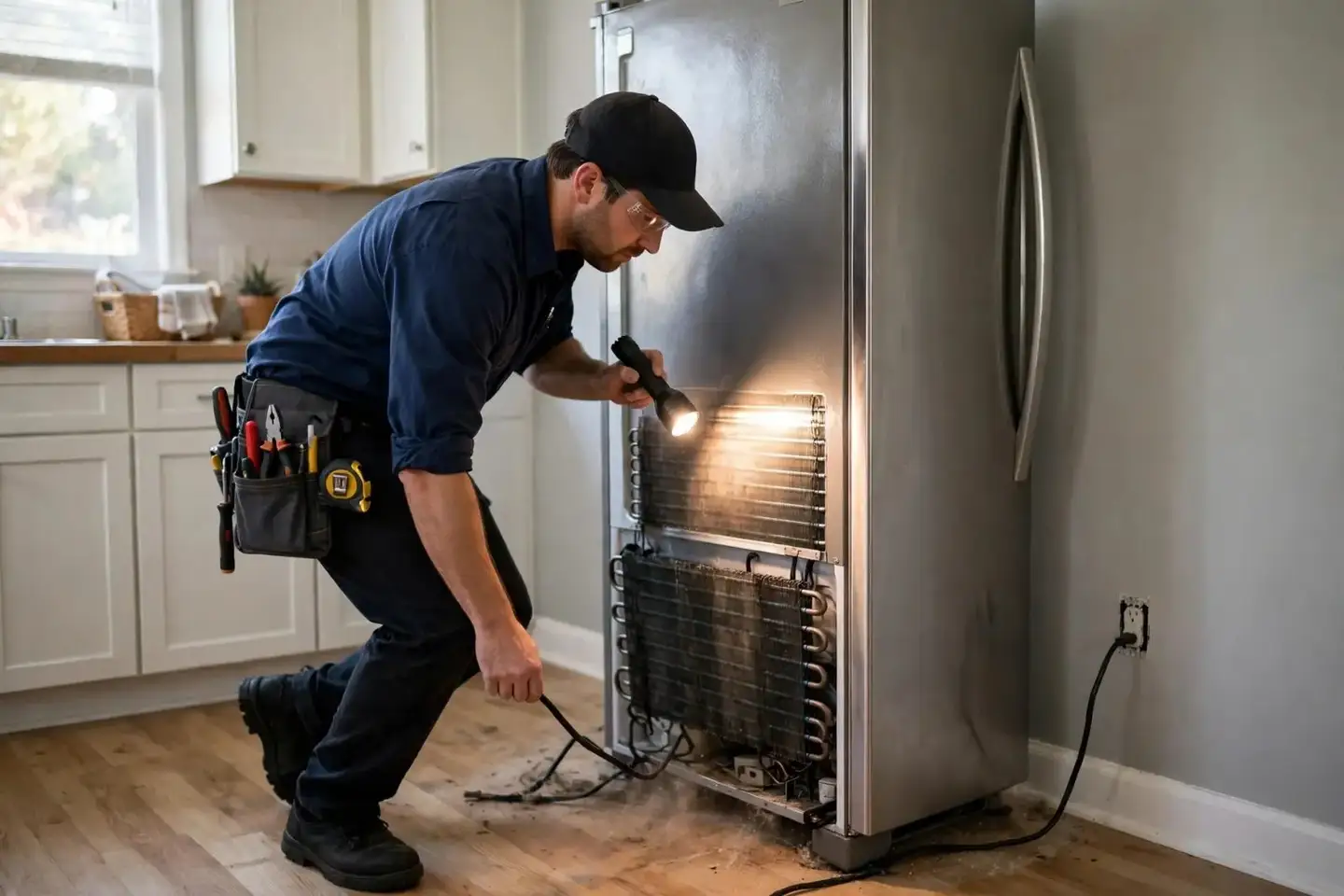
Start with the simplest explanation
Most refrigerator trouble shows up as a fridge that will not stay cold, and most of the causes are ordinary: a thermostat that was knocked, a door that does not seal, vents blocked by food, or dust on the coils at the back. Work through the simple checks first, one at a time, and give the fridge a few hours after each change before you judge the result. A refrigerator cools slowly, so a change made in the morning may not show until the afternoon. If the fridge is still warm after the simple checks, or the problem involves water, frost or a new sound, that is the point to stop and get a professional to look at it.
- Check the setting first
- Make sure the thermostat is set to a normal cooling level and that nobody has turned it down by accident. A control dial can be knocked when food is moved around, and a fridge switched off at the wall will not cool at all.
- Look at the door
- A door that does not close fully, or a seal that is torn or dirty, lets warm air in all day. Close the door on a sheet of paper: if it slides out easily, the seal is not gripping the way it should.
- Give it room to breathe
- Food packed tight against the vents inside, or a fridge pushed hard against the wall, can stop cold air from moving around. Leave a gap around the vents and a little space behind the fridge.
Five signs that mean act now, not later
Some symptoms are inconvenient. Others mean food is spoiling or water is getting where it should not. Treat these five as a reason to act the same day.
The fridge is warm while the freezer still freezes
When the freezer still freezes and the fridge section does not, cold air is not reaching the fridge. A blocked vent, a fan that has stopped or frost build-up is often behind it.
Water is pooling inside or underneath
A small puddle can come from a blocked drain or a drip tray that has been knocked out of place, but water that keeps coming back, or water under the fridge, needs attention before it damages the floor.
The fridge runs all the time or sounds louder
A fridge that never seems to switch off, or one that has started buzzing, clicking or knocking, is working harder than it should. Dusty coils and a worn door seal can both cause it.
Frost is building up where it should not
A thick layer of frost in a frost-free freezer, or ice around the door, usually means warm, damp air is getting in — often through a damaged seal or a door that does not close properly.
A smell that cleaning does not fix
Food spills cause most fridge smells, and they go away once the spill is found and cleaned. A smell that stays after a proper clean, especially a chemical or burning smell, is a reason to switch the fridge off and call a technician.
Safe checks you can do yourself
Do these in order, and stop at the first one that feels wrong. Nothing here needs tools, and nothing needs a panel removed. If you have to force anything, that is a job for a technician.
Confirm it has power
Check that the fridge light comes on when you open the door, that the plug is fully in, and that the outlet works. A tripped breaker or a loose plug is an easy fix — and an easy thing to miss.
Reset the thermostat
Turn the control back to its usual setting and wait. Give the fridge at least four hours before deciding whether the temperature has changed, and avoid opening the door every few minutes to look.
Test the door seal
Wipe the seal clean, then close the door on a sheet of paper at several points around the edge. If the paper pulls out with no resistance in one spot, that part of the seal is not doing its job.
Clean the coils at the back
Unplug the fridge first. The coils are usually at the back or underneath — brush the dust off with a soft brush or vacuum it away gently, then plug the fridge back in. Do not bend the coils or use water on them.
Clear the vents and level the fridge
Move food away from the vents inside both compartments, and check that the fridge sits level — a fridge that rocks can leave a door slightly open. Small adjustments to the feet can be enough.
What the symptom usually points to
Use this as a starting point, not a diagnosis. The same symptom can have more than one cause.
| What you notice | What often causes it | What to do next |
|---|---|---|
| Fridge warm, freezer cold | Blocked vent, a fan that has stopped or frost build-up | Clear the vents, check the seal and call a technician if it stays warm |
| Water on the floor | Blocked defrost drain or a drip tray out of place | Clear the drain if you can reach it safely; call a technician if water keeps returning |
| Fridge runs all the time | Dirty coils, a warm room or a worn door seal | Clean the coils, check the seal and give it a day |
| Clicking or buzzing | A fan, a relay or the compressor starting and stopping | Switch it off if the sound is loud or new and call a technician |
| Ice maker has stopped | A frozen feed line, a raised shut-off arm or a clogged filter | Check the arm and the water supply, then call a technician |
| Frost in a frost-free freezer | Warm air leaking in through a damaged seal | Check the seal and the door, and keep the door closed as much as possible |
If two or more of these symptoms appear together, or the fridge is warm and food is at risk, call a technician rather than working through the list.
Refrigerator repair questions, answered
How long can food stay safe in a fridge that has stopped cooling?
Not long. Once a fridge stops keeping food cold, move perishables to a cooler with ice, or to another fridge, while you work out the cause. Food that has spent hours in a warm fridge is not worth the risk: when in doubt, throw it out.
Why is my fridge running all the time?
A fridge runs longer when it has to work harder: dirty coils, a door that does not seal, a room that is very warm, or a fridge packed so full that air cannot move. Clean the coils and check the seal first. If it still runs without stopping, the cooling system may need a technician.
Should I unplug a fridge that is making a strange noise?
If the noise is a loud buzz, a grinding sound or a burning smell, switch it off and unplug it, then call a technician. For a new hum or click that is not getting worse, note when it happens — a technician will want to know whether it is constant or only when the compressor starts.
Can I fix a refrigerator leak myself?
You can check the simple causes: a blocked defrost drain, a drip tray that has been knocked out of place, or a water line that has come loose at the back. If you cannot see where the water is coming from, or it keeps coming back, leave it to a technician so a small leak does not become floor damage.
When should I call a professional instead of trying another fix?
Call a professional when the fridge stays warm after the simple checks, when water, frost or a smell keeps returning, when the noise is new and loud, or whenever a repair would mean removing a panel, touching wiring or opening the sealed cooling system. Those jobs need the right tools and training, and a mistake can make the problem worse.
This guide is general information, not professional, legal or insurance advice. Appliances, water conditions and local rules vary. Have a technician diagnose your appliance, and follow the manufacturer's instructions.
Want a technician to look at it?
Call to be connected with an independent appliance repair technician in your area.
(877) 686-5950Calls answered 24 hours a day, 7 days a week
Fixwell Appliance Repair is a referral service. Your call goes to an independent appliance repair technician who sets their own schedule. Ask about insurance and the repair warranty before work starts. How this works
Call now · 24/7
Talk to a technician by phone
Call Now (877) 686-5950Have this ready when you call
- Your ZIP code
- The appliance, brand and model number
- What is happening, any error code, and whether water or gas is involved
Gas smell, smoke or flames: leave and call 911 or the gas utility first.